Framework for a Simulation-Based Aerodynamic Shape Optimization of Bridge Decks for Different Limit State Phenomena
Abstract
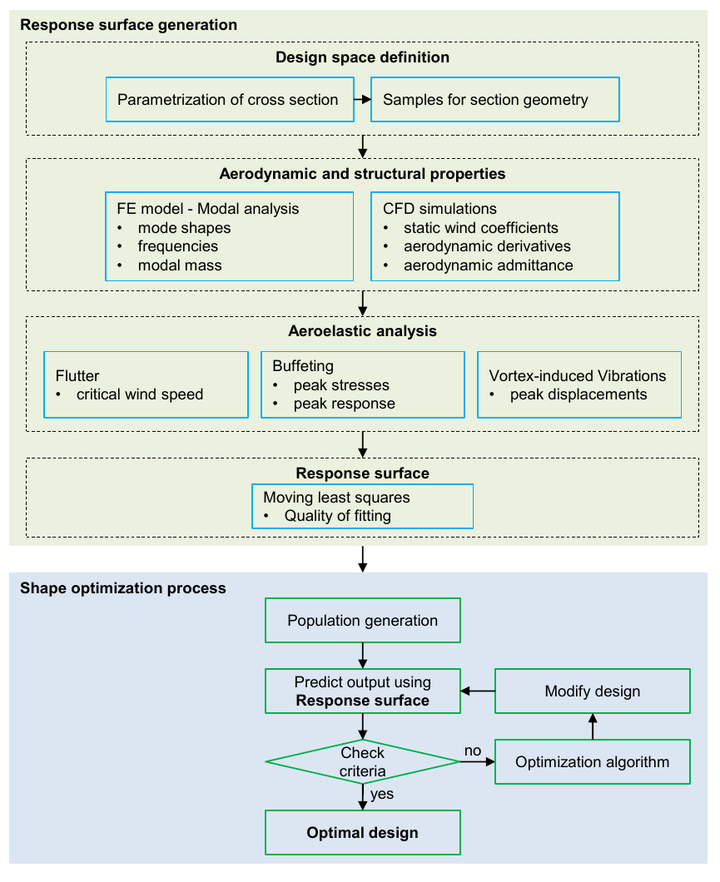
A computational framework is proposed for aerodynamic shape optimization of long-span bridge decks under flutter, buffeting and vortex-induced vibration constraints. Parameterized deck geometries are evaluated using computational fluid dynamics, structural and aeroelastic analyses, and response-surface approximations. Particle-swarm optimization then identifies a deck geometry with improved aerodynamic performance while maintaining the required carriageway width and structural capacity.
Type
Publication
arXiv preprint arXiv:2203.14414