Buffeting Analysis of Structures using Gaussian Processes with Semi-analytical Priors
Abstract
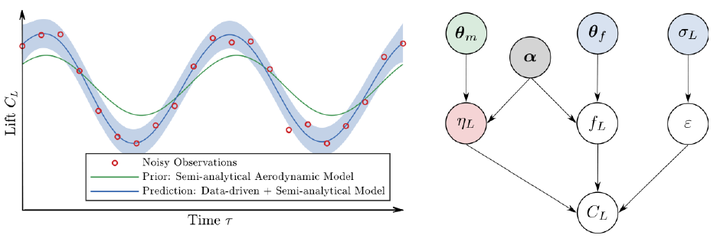
A hybrid methodology is presented for modelling aerodynamic forces on bluff bodies by combining the quasi-steady model with a Gaussian process that learns discrepancies caused by the quasi-steady assumption. The model uses nondimensional motion- and gust-induced angles of attack to predict probability distributions of lift and moment coefficients. Training data are generated through computational fluid dynamics with simultaneous structural motion and prescribed free-stream turbulence, and the model is assessed for large-amplitude forced vibration and buffeting response across several wind speeds.
Type
Publication
In Proceedings of the 9th International Colloquium on Bluff Body Aerodynamics and Applications (BBAA IX), University of Birmingham, Birmingham, UK, 29 July–2 August 2024